
The “E” in P/E Ratio Has Changed in 2026
In the simplest of terms, stock prices are driven by two forces:
- Earnings
- The price that investors are willing to pay for those earnings
And this year, estimates for the “E” in P/E ratio are trending up. As you can see in the chart, the 2026 and 2027 estimates for the Standard & Poor’s 500 are higher than they’ve ever been, following Q2 earnings revisions.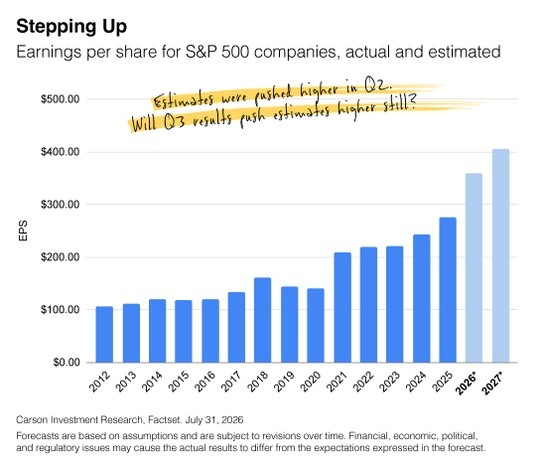
Why the change? Mostly it’s due to the rosy economic outlook. Gross Domestic Product increased by 1.5 percent in Q2, and the Atlanta Fed’s GDPNow estimate for Q3 was more than 5 percent on Aug. 6.
So despite the mixed signals from the Fed on short-term interest rates and inflation, S&P 500 companies are having a banner year and that trend is expected to continue into 2027. But before you start popping the champagne, remember that September and October can be volatile, so while optimism is in the air, it may come face-to-face with some short-term price swings.
Stay focused and committed to your strategy. And if the markets get bumpy, take a moment and ask yourself, “Is there any news associated with the short-term price swings that would change the long-term outlook that companies are talking about?”
Market Insight
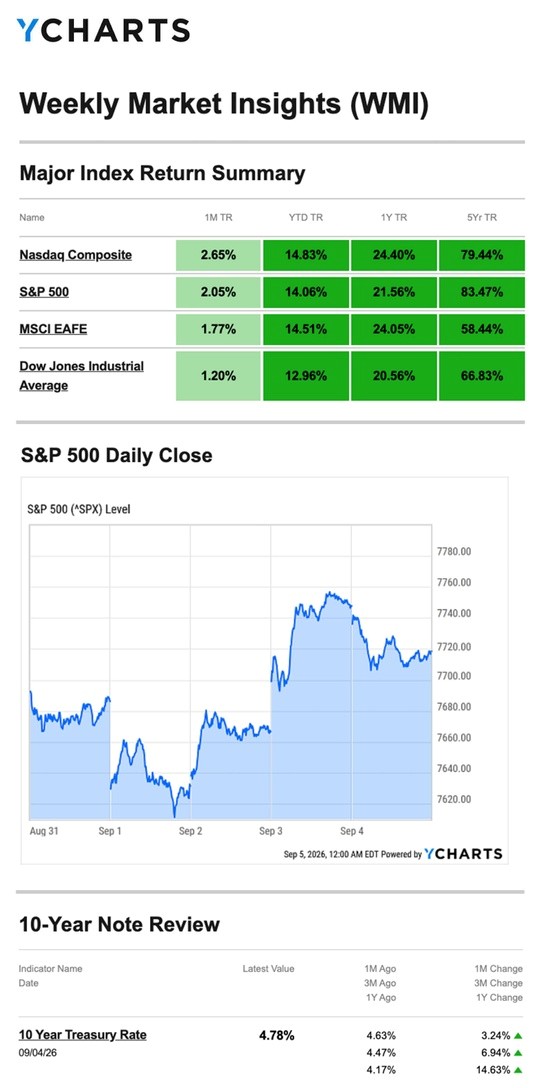
Stocks were mixed last week as markets continued to navigate geopolitical concerns and new signals about short-term interest rates. The Standard & Poor’s 500 Index edged up 0.09 percent, while the Nasdaq Composite Index rose 0.40 percent. The Dow Jones Industrial Average slipped 0.27 percent. The MSCI EAFE Index, which tracks developed overseas stock markets, skidded 0.25 percent.
Summer’s Final Act
Stocks fell modestly, and oil prices rose at the start of the week after renewed tensions in the Middle East put investors on edge. Longer-maturity Treasury bond yields also rose, adding pressure on stocks. Stocks remained under pressure as global bond yields rose, with traders fretting that higher oil prices would stoke broader inflation. Benchmark government bond yields for the U.S., Germany and Japan hit 20-month, 15-year, and 30-year highs, respectively.
But midweek, stocks rebounded after Fed Governor Christopher Waller suggested that the Fed might leave interest rates unchanged at its meeting later this month. Each major average gained 1 percent or more.
Before Friday’s opening, the Labor Department’s nonfarm payrolls report showed job growth was stronger than expected in August. Stocks were under pressure all day as traders saw the job report as a reason that the Fed might consider adjusting rates later this month.
Jobs Update
Wednesday’s ADP National Employment Report showed private-sector hiring slowed in August, as companies added 38,000 jobs. That was one of the reasons why Friday’s nonfarm payrolls report surprised investors. The entire U.S. economy added 162,000 jobs in August. That was triple the 53,000 job gain economists expected and the biggest jump in five months. The unemployment rate also remained unchanged at a historically low 4.1 percent.
AI in 2027
Almost daily, companies give glimpses into their internal struggles in managing the pace of change driven by AI. In late August, a Goldman Sachs partner warned on the firm’s own podcast that in the era of AI, “we outsource our reasoning to these models, and we have cognitive atrophy.” In other words, one of Wall Street’s most powerful firms is openly asking how to use these tools without losing the judgment that makes its people valuable. A short time later, The Wall Street Journal confirmed that no rules were violated when an influential investor said he used artificial intelligence to write an op-ed.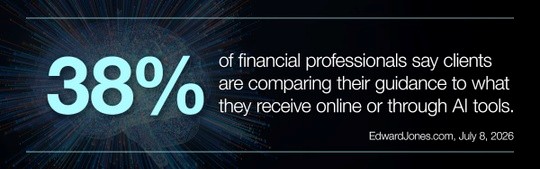
If institutions with this much influence are still finding their footing, it’s fair to say the rest of us are climbing the learning curve too.
Please reach out to Adams Brown Wealth Consultants if you have any questions about the market or financial planning.
Sources
YCharts.com, Sept. 5 – Weekly performance is measured from Monday, Aug. 31 to Friday, Sept. 4.
AtlantaFed.org, August 12, 2026
CNBC.com, Sept. 1, 2026